

Blog
Full overlay, partial overlay or inset — which do I have?

This is the first thing to settle and the thing most people settle last. How your doors sit on the cabinet decides the size you order, so working it out after you have measured means measuring again.
It takes about thirty seconds, standing in your own kitchen, with nothing but your eyes.
The thirty-second test
Close two doors that sit next to each other — a pair under a worktop is ideal — and look at the vertical line where they meet.
- You can barely see any cabinet between them. The doors almost touch, with a gap you could slide a couple of credit cards into. That is full overlay.
- There is a visible strip of painted or stained cabinet between them, roughly an inch to an inch and a half wide, and it runs the full height. That is partial overlay, sometimes sold as standard or traditional overlay.
- The doors sit down inside the cabinet, flush with the front of it, with an even gap all the way round each one and the frame visible on every side. That is inset.
If none of those fit because there is no frame at all — the doors cover the raw edges of the cabinet box, and opening one shows you plywood or melamine rather than a painted frame — you have frameless cabinets, and that is covered further down.

What each one actually is
Full overlay
The door is larger than the opening and covers nearly the whole face frame. A full-overlay kitchen reads as a wall of doors, because the frame underneath is almost entirely hidden and the only lines you see are the narrow gaps between doors.
Those gaps are the reveal, and on a full-overlay kitchen the reveal is the look. It is usually somewhere around an eighth of an inch, it is consistent across the whole run, and it is unforgiving — a door a sixteenth out shows. Our guide on the reveal between cabinet doors goes into what to leave and why.
Partial overlay
The door overlaps the frame by around half an inch on each edge, so between two doors you see an inch or so of frame. This is what the majority of American kitchens built before roughly 2000 use, and it is the most forgiving of the three: the frame between the doors absorbs small inconsistencies, so a door that is a sixteenth off does not announce itself.
It is also the cheapest to replace into, because the hinges are usually staying.
Inset
The door sits inside the opening, flush with the face of the frame, with a small even gap around all four sides. It is the oldest of the three and the most exacting to build, because every door is surrounded by a line that has to be right on four sides rather than two.
It is also the one where the door size is least forgiving. An overlay door that is a sixteenth large still closes. An inset door that is a sixteenth large does not go in.
Frameless
No face frame at all. The doors mount to the sides of the box and cover its edges completely, so the construction is closer to full overlay in appearance but the sizing arithmetic is different — you are working from the box, not from an opening in a frame.
Frameless is standard in European and most contemporary cabinetry, and it gives marginally more usable space inside because there is no frame narrowing the opening.
The hinge is the other way to tell
If the test above left you unsure, open a door and look at the hinge.
- A hinge that is invisible with the door closed, sitting in a round recess bored into the back of the door, is a concealed European hinge. Those are used on full overlay, frameless, and increasingly on partial overlay too.
- A hinge with one visible leaf wrapping around the frame is a semi-concealed wrap-around, and it is almost always partial overlay.
- A hinge visible from the front as two knuckles, or a concealed hinge with a straight arm and no overlay crank, points at inset.
Concealed hinges have the overlay stamped or printed on the arm surprisingly often, and our cabinet hinge overlay size chart lets you read your overlay straight off the hinge rather than inferring it. That is the fastest reliable answer there is.
Why this has to come before measuring
Because the conversion from opening to door is different in each case, and it is the conversion you are about to do.
- Overlay doors are the opening plus twice the overlay — a 12" opening with a 1/2" overlay wants a 13" door.
- Inset doors are the opening minus the gap you want all round, which means the opening has to be measured accurately in both directions and often in more than one place, because an old frame is rarely square.
Get the overlay wrong and every number on your sheet is wrong by the same amount, which is exactly the kind of error that survives being checked twice. How to measure for replacement cabinet doors picks up from here, once you know which of the three you are working with.
Can you change from one to another?
Sometimes, and it is worth knowing which direction is easy.
Partial to full overlay is usually possible. The frame is already there and you are simply covering more of it, so it is a bigger door and new hinges. The catch is the old hinge holes in the frame, which have to be filled — invisible under paint, visible under stain — and cabinets that sit hard against a wall or each other, where a bigger door may have nowhere to swing.
Overlay to inset is a different job. The frame openings have to be true and square for an inset door to look right, and on a thirty-year-old kitchen they usually are not. It is possible, but it is cabinetry work rather than a door order.
Keeping what you have is the cheapest answer, and if the existing hinges and holes are staying, new doors into existing hinge holes is the guide that matters most.
Then the part you came for
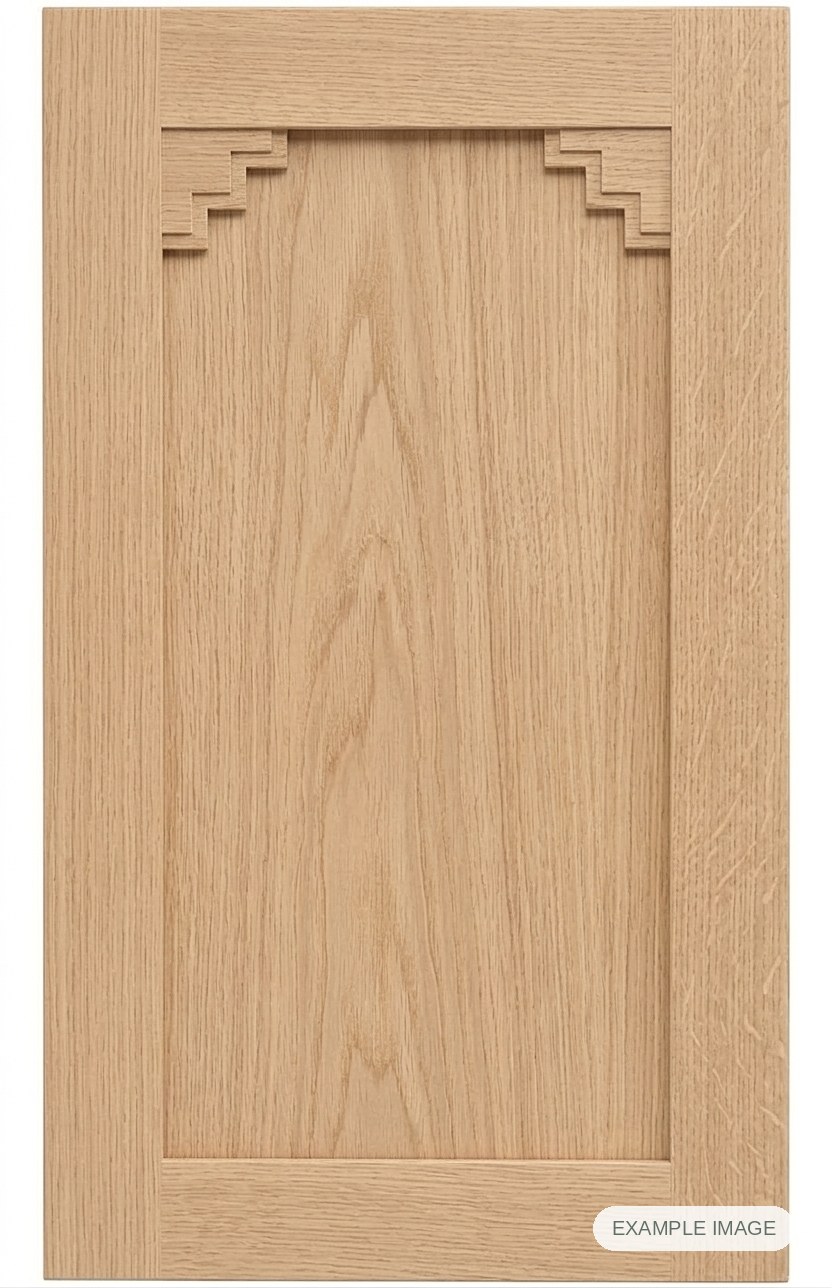
One thing worth clearing up, because the words collide: an inset panel door means the centre panel is flat and recessed within the door. It has nothing to do with whether the door is mounted inset in the frame. You can have an inset panel door on a full-overlay kitchen, and a raised panel door mounted inset. They are separate decisions that happen to share a word.
Every door here is cut to the size you enter in 1/16" increments, with no minimum order, so whichever of the three you have, the size is not a constraint — the arithmetic just has to be right. Browse the door range, or send us a photo if the thirty-second test did not give you a clear answer.