Summer 25% discount on all last year's products home decor


How thick are cabinet doors?

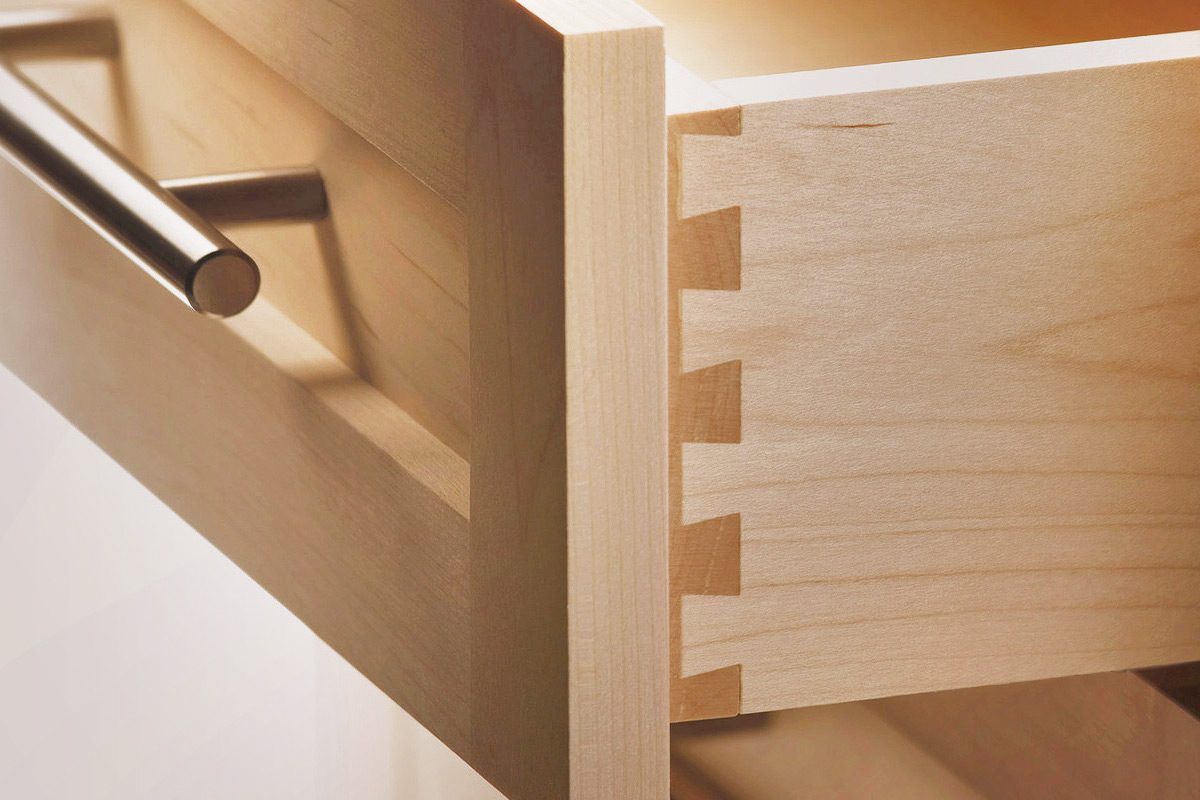
Our shaker and thermofoil doors are 3/4 inch thick, the standard for a cabinet door. Raised panel doors are 13/16 inch, a sixteenth more, because the panel stands proud of the frame. That figure matters more than it sounds, because hinge boring depth and how the door sits against the cabinet are designed around it.
| Thickness | What it means | Watch out for |
|---|---|---|
| 3/4 inch — our shaker and thermofoil | The standard. Hinges, plates and boring all assume it | Nothing; this is what hardware is designed around |
| 13/16 inch — our raised panel | A sixteenth more, to carry a panel that stands proud of the frame | Nothing; concealed hinges take it in their stride |
| Thinner than 3/4 inch | Lighter, and common in manufactured housing | A 13mm hinge bore may break through the face |
| Thicker than 3/4 inch | Heavier, usually a specialist or exterior-grade door | Standard hinges may not close the door flat |
How thick are cabinet doors?
Three-quarters of an inch on most of them, and that is the standard across the cabinet trade for a solid door.
There is one exception worth knowing before you measure: our raised panel doors are 13/16 inch, a sixteenth thicker, because a raised panel stands proud of the frame rather than sitting flat inside it. Shaker and other inset-panel doors, and every thermofoil door, are 3/4 inch.
A sixteenth sounds like nothing and mostly is. It matters in exactly one situation — matching a door to an existing kitchen — which is the reason most people ask this question in the first place.
Why does 3/4 inch matter?
Because every piece of hardware you are going to hang on the door was designed around it.
A concealed hinge sits in a cup bored into the back of the door. Ours is 35mm across and 13mm deep, set 3mm in from the edge. On a 3/4 inch door, a 13mm bore leaves roughly a quarter of an inch of material between the bottom of the cup and the front face. That is enough to hold a hinge under load, and enough that nothing telegraphs through the finish.
Take the door down to 1/2 inch and that margin largely disappears. That is not a theoretical problem; it is how a hinge cup ends up visible as a circle on the front of a painted door.
How do I measure my existing doors?
Open a door and measure the edge, not the face. Any point on the edge will do, but measure at a corner rather than in the middle where a slight bow could flatter the reading.
If you get something very close to 3/4 inch, you have a standard door. If you get noticeably less, your kitchen was built lighter than standard — common in manufactured housing, where weight matters because the home is transported, and not unusual in budget kitchens.
Measure more than one. A kitchen that has had doors replaced over the years can easily carry two thicknesses, and it is the sort of thing nobody notices until a hinge will not sit right.
What happens if I replace thin doors with 3/4 inch ones?
Usually it is an improvement, and there are two things to plan for.
Weight. A solid 3/4 inch door is heavier than a thin one. The hinges and the cabinet side have to carry it. Check what your existing hinges are rated for, and if in doubt, change them — we recommend Blum and Salice and sell the mounting plates alongside the doors, so the set can arrive together.
What the cabinet side is made of. If the sides are thin, a screw into them will not hold a heavier door for long. We do not build with particle board and never have, but plenty of older and manufactured kitchens were, and it changes what hardware makes sense rather than stopping the job.
The third thing, which is not a problem but surprises people: a thicker door sticks out further. On a run where every door changes together, nobody notices. If you are replacing three doors in a kitchen of twenty, you will see the difference.
Does thickness change the hinge boring?
Not the diameter. A 35mm cup is a 35mm cup on any door.
What thickness governs is depth. Our 13mm bore suits a 3/4 inch door. On a thinner door that depth is too much, and the answer is a shallower bore or a different hinge rather than pressing on and hoping.
If you are ordering doors to match an existing boring, send the depth along with the other measurements — the cup diameter, how far it sits from the edge of the door, and how far its centre sits from each end. Four numbers, and they take five minutes off a door you have already taken down to measure.
Are thicker doors better?
Past 3/4 inch, no, and the honest answer is that thicker is mostly a disadvantage in a kitchen.
A thicker door is heavier, which is more load on the hinges and the cabinet for no gain in how it looks or lasts. Standard hardware assumes 3/4 inch, so going above it can mean a door that will not close flat. There are cases where a thicker door makes sense — a very large door, or a piece doing something unusual — and they are exactly the cases worth discussing rather than ordering blind.
Where extra thickness genuinely shows is in the door’s construction rather than its overall dimension: what the frame is made from and how the panel is held in it matter far more to whether a door stays flat over twenty years.
Is a thermofoil or MDF door the same thickness?
Yes. A thermofoil door is 3/4 inch, the same as a shaker door. What differs is the construction rather than the dimension: thermofoil is a vinyl foil pressed onto a routed MDF core, so the face and the profile are a single piece with no joint to open up.
That matters for how the door behaves over time, and not at all for whether your hinges fit.
What do I need to tell you when I order?
Nothing about thickness. Each door style already comes at the thickness that suits it — 3/4 inch for shaker and thermofoil, 13/16 for raised panel — so choosing the style chooses the thickness.
What you do need to give is the width and height of every door and drawer front, measured individually, and your boring — press-in with two 8mm dowel holes, screw-in with the cup alone, or blank. Doors are made from 5 inches by 8 inches up to 49 by 96, in sixteenth-of-an-inch increments, two weeks from order to shipped.
Frequently asked questions
Are all kitchen cabinet doors 3/4 inch thick?
Most are, and it is the standard hardware assumes. Raised panel doors run a sixteenth thicker at 13/16 inch, because the panel stands proud of the frame. Thinner doors turn up in manufactured housing and at the budget end, where weight and material cost matter more than longevity.
Can I order doors thinner than 3/4 inch?
Ask before you order. It is possible, but a thinner door limits how deep the hinge cup can be bored, and that is the constraint rather than the making.
Will a thicker door still close properly?
Only if the hinge suits it. Standard concealed hinges are designed around 3/4 inch, and a thicker door can foul the cabinet or refuse to sit flat. Tell us if you are considering one.
How thick are drawer fronts?
The same as the doors they sit with — 3/4 inch alongside shaker, 13/16 alongside raised panel. A drawer front carries almost no load because it is fixed to the drawer box, but matching the door keeps the whole kitchen reading as one piece.
Does door thickness affect the price?
Doors are priced per square foot, so the face area is what drives the figure rather than the thickness.
3 thoughts on “How thick are cabinet doors?”