Summer 25% discount on all last year's products home decor


Five-piece or slab drawer fronts — which should I choose?

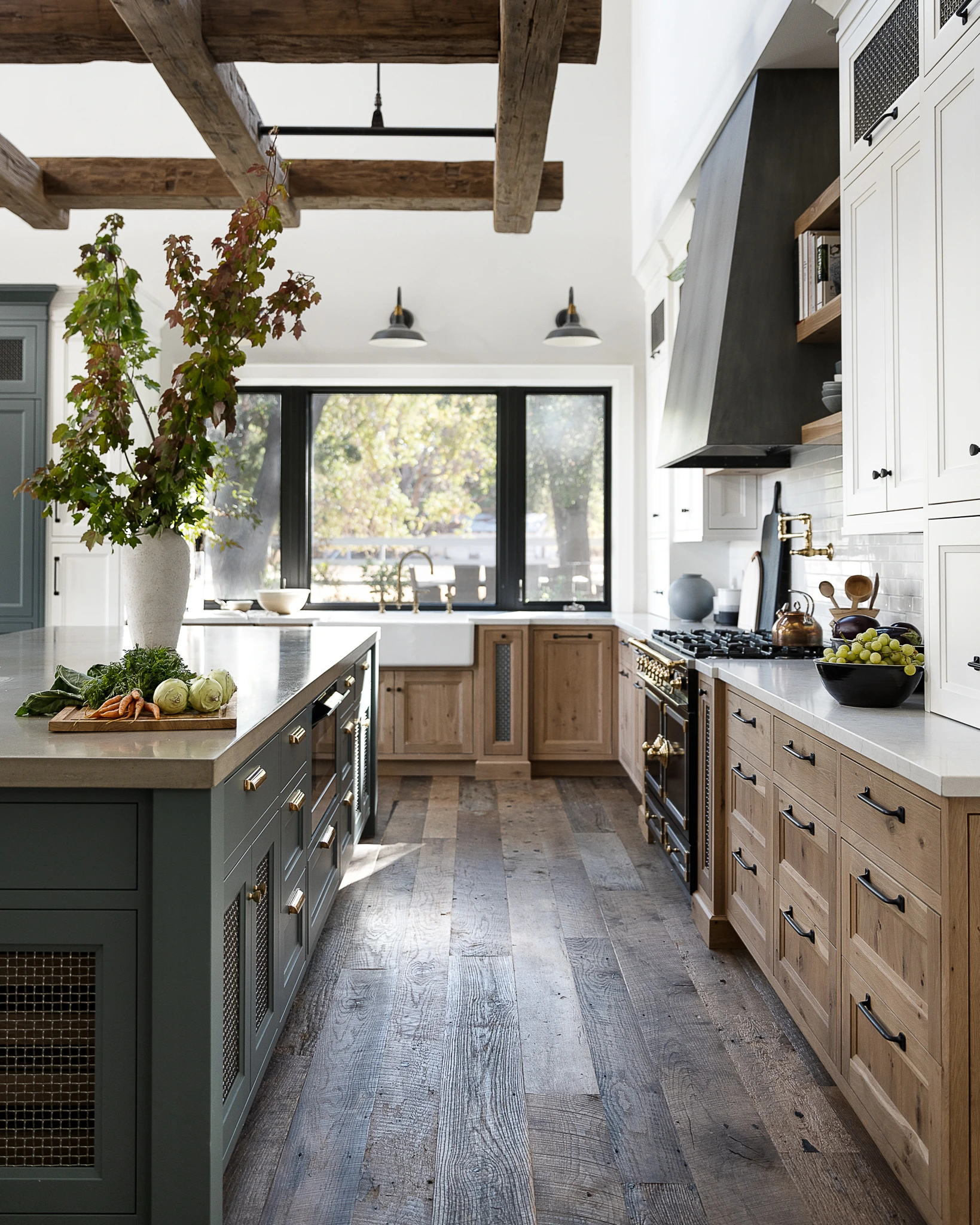
A five-piece front is built like a door, with a frame around a centre panel, so it matches shaker doors exactly. A slab is one flat panel with no frame. Use five-piece on deep drawers where the frame has room to read, and slab on shallow drawers where it does not.
| Five-piece | Slab | |
|---|---|---|
| Construction | Frame around a centre panel, like a door | One flat panel |
| Matches shaker doors | Exactly — same frame, same proportions | Deliberately does not; reads as a contrast |
| On a deep drawer | Good. The frame has room to be seen | Good. Clean and quiet |
| On a shallow drawer | Awkward. The frame crowds the panel out | Good. The usual answer |
| Shows wood grain | Broken up by the frame | Runs across the whole front uninterrupted |
What is the difference between a five-piece and a slab drawer front?
A five-piece front is made the way a door is made: two vertical stiles, two horizontal rails, and a panel in the middle. Five pieces, hence the name. Put it next to a shaker door and it is the same object in a different proportion.
A slab front is one flat panel. No frame, no joints on the face, nothing to catch the eye.
That is the whole technical difference. Everything else is about where each one looks right.
Which one matches my doors?
Five-piece, if your doors are shaker or any other framed style. It is the same construction, so the frame width, the shadow line and the way light falls on the panel all agree with the doors above and below.
Slab is the right match when your doors are also slab — flat-panel or thermofoil kitchens — where introducing a framed drawer front would be the only framed thing in the room.
There is a third case that comes up more than people expect: shaker doors with slab drawer fronts, chosen deliberately. It is a real look and it works in a modern kitchen, but it has to be all the drawers rather than some of them, or it reads as a supply problem rather than a decision.
Why do shallow drawers change the answer?
This is where the decision is actually made, and it is the part most comparisons skip.
A five-piece front needs enough height for the frame to have a panel inside it. On a deep drawer there is plenty. On the shallow top drawer of a bank — the cutlery drawer, the one most kitchens have three or four of — the rails at top and bottom nearly meet, and what should be a framed panel becomes a thin slot with a frame around it. It looks cramped, and it looks accidental rather than designed.
The usual answer in a shaker kitchen is therefore not “five-piece everywhere”. It is five-piece on the deep drawers, slab on the shallow ones. Done consistently, nobody reads it as a compromise, because the eye accepts that small fronts are different objects.
Where the cutoff sits depends on the frame width, so it is worth asking rather than guessing on a kitchen with a lot of shallow drawers.
Which is better for showing off the wood?
Slab, without much argument.
A slab front is one continuous surface, so grain runs across the whole face uninterrupted. On a bank of drawers in something like rift white oak, that is the entire point — and it opens up sequencing the fronts so the grain carries from one drawer to the next down the bank.
A five-piece front breaks the face into a frame and a panel, so the grain in the panel is contained and the frame runs in two directions around it. On a painted kitchen this does not matter at all, which is why five-piece and paint are such a common pairing.
Is one stronger than the other?
Neither, in the way that matters. A drawer front carries almost no structural load — it is fixed to the front of the drawer box, which is the part doing the work.
What does differ is how each one handles seasonal movement. A framed front has a panel that can move slightly within its frame, which is why solid-timber doors are built that way. A slab front is one piece, so its behaviour depends entirely on what it is made from: an engineered core is stable by construction, solid timber needs the width considered.
On a wide drawer front in solid timber, that is a conversation worth having before ordering rather than after.
Do they cost the same?
Both are priced per square foot, so a front of a given size is a front of a given size. What changes the number is the area, the species and the finish rather than the construction.
One thing to know before you assume small fronts are nearly free: there is a minimum of 2 square feet per piece. A shallow cutlery drawer front is built at whatever size you give and charged at that minimum, so a bank of four shallow drawers does not cost proportionally less than its square footage suggests.
Which one suits a painted kitchen?
Either, and this is the case where the decision is purely about how you want it to look rather than about the material.
Paint hides grain, so the argument for slab — an uninterrupted face — loses most of its force. What is left is the shadow line. A five-piece front in paint gives you a crisp recess around the panel that catches light and gives a flat colour something to do; a slab in paint is a plain rectangle, which can be exactly right in a very modern kitchen and can look blank in a traditional one.
If you are painting and cannot decide, five-piece on the deep drawers is the safer choice, because it agrees with shaker doors without anyone having to think about it.
What do I need to tell you when I order?
The width and height of each front, measured individually, and which construction you want for each.
Measure the existing front rather than the drawer box, because the front is usually wider and taller than the box it is screwed to. If you are replacing fronts and keeping the boxes, note how the current ones are fixed — most are screwed through the box front from inside — and a photograph of the back of one answers the question faster than a description.
Fronts are made from 5 inches by 5 inches upward, in sixteenth-of-an-inch increments, so whatever you measure is what gets built. Two weeks from order to shipped.
Frequently asked questions
Can I mix five-piece and slab fronts in one kitchen?
Yes, and it is the normal answer in a shaker kitchen: five-piece on the deep drawers, slab on the shallow ones. The rule is to be consistent about it — all the shallow ones, not some of them.
Which drawer front is easier to keep clean?
Slab. There are no frame corners for anything to collect in, which is the practical argument for slab in a busy kitchen regardless of the styling.
Do slab fronts look cheap?
Not inherently. The association comes from the budget end of the market having used them, not from the construction itself. A slab front in a good species, with the grain sequenced down a bank of drawers, is the opposite of cheap-looking.
What size is too small for a five-piece front?
It depends on the frame width, since the frame is what eats the available height. On a shallow drawer the two rails end up nearly touching. Ask before ordering if you have a lot of shallow drawers.
Can I match new drawer fronts to my existing doors?
In construction, yes. In colour, order a sample first — matching an existing finish from a photograph is not reliable, and a drawer front sits at eye level where any difference shows.
One thought on “Five-piece or slab drawer fronts — which should I choose?”