Summer 25% discount on all last year's products home decor


How are cabinet doors priced per square foot?

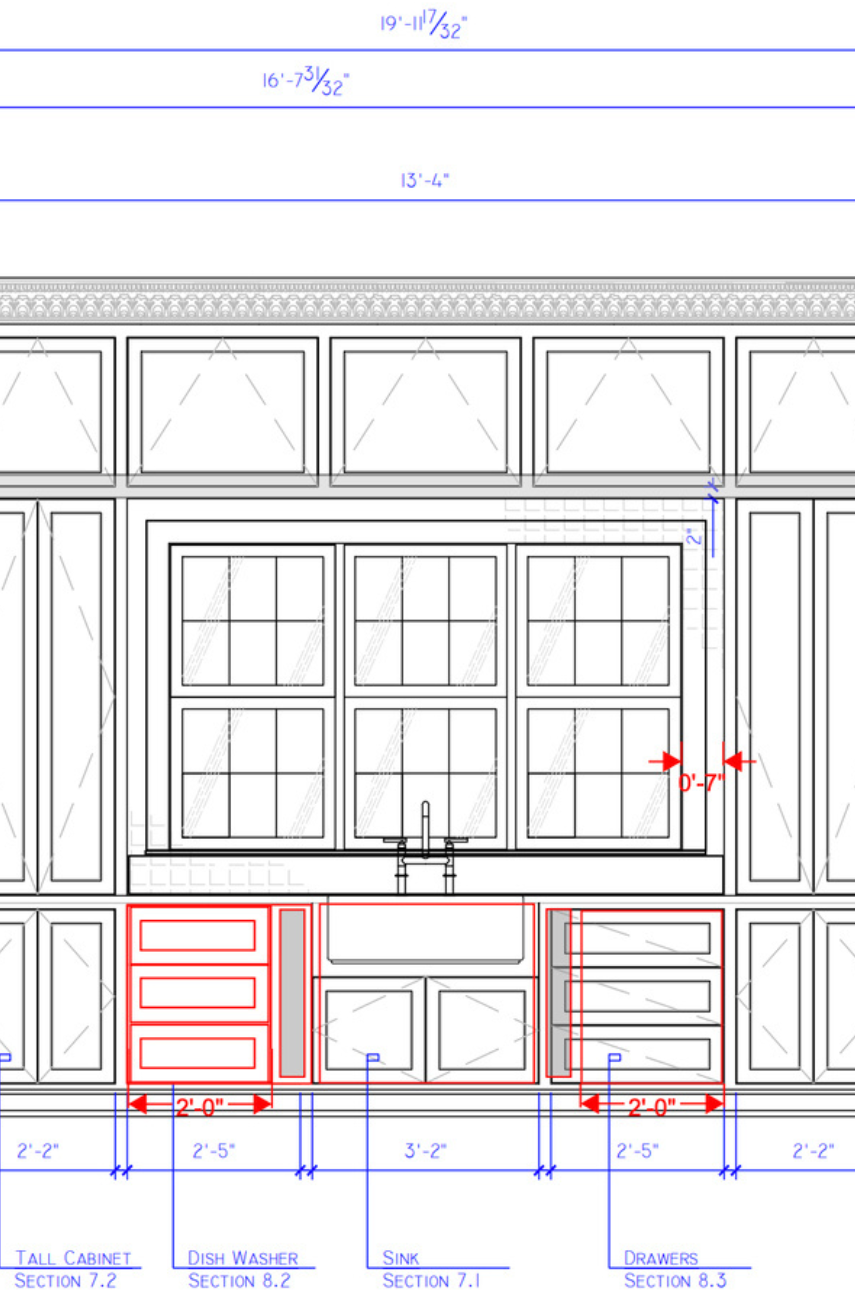
Multiply the width by the height in inches, divide by 144 to get square feet, then multiply by the rate for that door. A minimum of 2 square feet applies per piece. That is the whole calculation, and it is why two doors of the same style can be very different prices.
| Door size | Square feet | Charged at |
|---|---|---|
| 24 by 30 inches | 720 ÷ 144 = 5.00 sq ft | 5.00 sq ft |
| 15 by 24 inches | 360 ÷ 144 = 2.50 sq ft | 2.50 sq ft |
| 12 by 12 inches | 144 ÷ 144 = 1.00 sq ft | 2.00 sq ft — the minimum |
How are cabinet doors priced per square foot?
Width times height, divided by 144, times the rate for that door.
That is genuinely all of it. The reason this page exists is that almost nobody selling doors will show you the arithmetic — the usual answer is a range like “$50 to $500 per door”, which is true, useless, and tells you nothing about why your door sits where it sits in it.
Why 144?
Because there are 144 square inches in a square foot — 12 times 12. Measuring a door in inches and pricing it in square feet means one division, and that division is the step people miss.
So a door 24 inches wide and 30 inches tall is 720 square inches, which is 5 square feet exactly. A door 15 by 24 is 360 square inches, or 2.5 square feet.
What is the rate?
It depends on the door style and the species or finish you choose, and it is shown on every product page.
To put real numbers on it: on our Shaker door the published range runs from $13.84 to $36.79 per square foot depending on what it is made from. So the same 24 by 30 inch door — 5 square feet — is:
- 5 × $13.84 = $69.20 at the bottom of that range
- 5 × $36.79 = $183.95 at the top
Same door, same size, same construction. The difference is entirely what it is made from, which is the thing a “$50 to $500 per door” range hides from you.
What is the 2 square foot minimum?
Every piece is charged at a minimum of 2 square feet, however small it actually is.
This catches people out, so it is worth being blunt about. A 12 by 12 inch door is 1 square foot of material, and it is charged as 2. At $13.84 that is $27.68 rather than $13.84.
The reason is that a small door is not half the work of a big one. It gets cut, assembled, finished, bored, inspected and wrapped exactly like any other — the machine time and the handling barely change with size. Below a certain point the square footage stops describing the job.
The practical consequence is that a kitchen with a lot of small drawer fronts does not cost proportionally less than its total square footage suggests. Worth knowing before you add it up.
Why price by the square foot at all?
Because it is the only honest way to price a door that is made to your dimensions.
A supplier selling fixed sizes can put a price on each size, because there are only a dozen of them. When every door is cut to whatever you ask for, in sixteenth-of-an-inch increments from 5 by 8 inches up to 49 by 96, there is no list of sizes to put prices against. There is only a rate and a measurement.
It also means you are never paying for material you did not ask for. On a fixed-size range, a door that is close to your opening but not exactly it costs the same as one that fits — and then you fill the gap with a strip of trim.
How do I work out what my own doors will cost?
Measure each door and each drawer front, width and height. Then for each one:
- Multiply width by height to get square inches
- Divide by 144 to get square feet
- If the answer is under 2, use 2
- Multiply by the rate shown on the product page for your style and species
Or skip all of it: every product page has the width and height boxes on it, and entering your dimensions gives you the price for that door directly. The arithmetic above is there so you understand the number, not because you have to do it.
Does the style change the price as much as the species?
Both move it, and the material is usually the bigger lever. A more complicated door has more machining in it; a more expensive timber costs more per square foot before anything is done to it.
What does not change the price is how the face is divided. A shaker door with 2 1/4 inch frames and a flat panel is priced on its area, not on the ratio of frame to panel. Nor does the thickness, which is 3/4 inch as standard across the range.
What else is in the price, and what is not?
The rate covers the door made to your size and finished, ready to hang. Hinge boring is part of the order — press-in with two 8mm dowel holes, screw-in with the cup alone, or blank — rather than a separate line to discover later.
Shipping is separate and depends on where the doors are going. Hinges and mounting plates are separate items, which we sell, so a full set can arrive together.
What there is not, anywhere, is a size surcharge. A door at an awkward dimension costs what its square footage costs, because every door here is at an awkward dimension. That is the entire point of the shop.
What does a whole kitchen come to?
Add up the square footage of every door and drawer front, remembering the 2 square foot minimum on the small ones, then multiply by your rate.
For a sense of scale: a kitchen of around twenty-five doors and fronts is roughly a hundred square feet of material. At the bottom of the Shaker range that is in the region of $1,400; in a more expensive species it climbs toward $8,000.
Worth holding that against what it replaces. A new kitchen starts at $15,000 and goes up from there, and most of that money is the boxes, the worktop, the plumbing and the weeks the room is unusable — none of which a reface touches.
These are arithmetic rather than a quote. Your kitchen has its own count and its own sizes, which is exactly what the width and height boxes on each product page are for.
How do I compare this with a fixed-size supplier?
Work out your square footage first, then compare like with like.
The comparison that catches people is that a fixed-size door which is close to your opening is not the same product as a door that fits it. Once you add the filler strips, the trim, and the doors you have to order oversized and cut down, the per-square-foot figure is the only number that compares honestly.
And where a fixed-size range simply has nothing near your opening — which is the normal case in older and manufactured homes — there is no comparison to make.
Frequently asked questions
How do I calculate the square footage of a cabinet door?
Multiply the width by the height in inches, then divide by 144. A 24 by 30 inch door is 720 square inches, which is exactly 5 square feet.
Why is there a 2 square foot minimum?
Because a small door takes nearly as long to make as a large one. It is cut, assembled, finished, bored and wrapped the same way, so below a certain size the square footage stops describing the work.
Is a bigger door cheaper per square foot?
No, the rate is the rate. What changes with size is only the number of square feet you are buying, apart from the 2 square foot minimum at the small end.
Does the price include hinge boring?
Boring is chosen on the order rather than added afterwards, whether that is press-in with the two 8mm dowel holes, screw-in with the cup alone, or blank.
Does the price include shipping?
No. Shipping depends on where the doors are going and is worked out separately from the door price.
Can I get a price without ordering?
Yes. Every product page has width and height boxes on it, and entering your dimensions shows the price for that door immediately. Nothing is committed by trying it.
2 thoughts on “How are cabinet doors priced per square foot?”