Summer 25% discount on all last year's products home decor
Raised panel cabinet doors, and how to match the ones you have

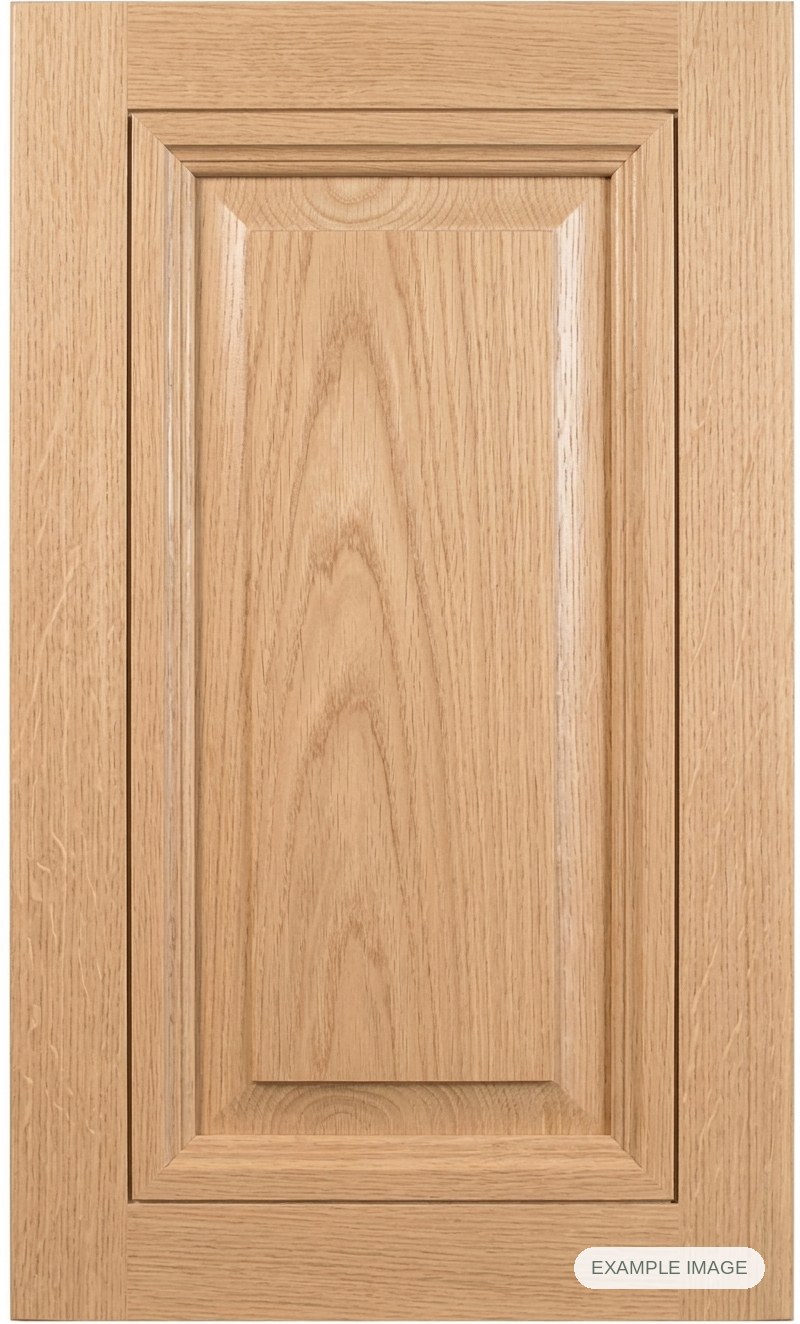
A raised panel door has a centre panel machined so it stands proud of the frame, rather than sitting flat inside it. If you are matching an existing kitchen, the four things to identify are the profile, the frame width, the panel type and the species. Ours are made to your sizes in 1/16 inch steps.
| Raised panel | Shaker / inset panel | |
|---|---|---|
| The panel | Machined so it stands proud of the frame | Flat, sitting inside the frame |
| Thickness | 13/16 inch | 3/4 inch |
| Frame width | Up to 3 inches; all widths 3 inches and under cost the same | 2 1/4 inches as standard |
| Reads as | Traditional | Neutral; the current default |
| Usual reason to choose it | Matching a kitchen you already have | Starting fresh |
What is a raised panel door?
A door whose centre panel is machined with a profile so that it stands proud of the frame around it, catching light across its face. Set one beside a shaker door, where the panel is flat and sits inside the frame, and the difference is obvious even to someone who could not name it.
It is the traditional cabinet door, and it is what most kitchens built before about 2000 have.
How do I match the doors I already have?
This is why most people are reading, so it goes first. There are four things to pin down, and a tape measure and a photograph will get you three of them.
The profile. This is the shape machined into the panel and the inside edge of the frame, and it is what makes two raised panel doors look different from each other. It is almost impossible to name from memory and easy to identify from a photograph — take one straight on and one at a shallow angle so the light rakes across the profile and throws a shadow.
The frame width. Measure from the outer edge of the door to where the frame meets the panel, on a stile rather than a rail. Anything up to 3 inches is available, and every width at or below 3 inches is the same price, so this is a matching decision rather than a budget one.
The panel type. Look at the panel edge where it meets the frame. A solid panel is one piece of timber. A veneer panel has a visible layer line if you look closely at an exposed edge. See the section below.
The species. Hardest to judge from a photograph, particularly under a finish that has aged. If you are unsure, order a sample — it costs a fraction of a door, it is mailed out the same day you order, and it is the only honest way to compare grain and colour in your own kitchen’s light.
Send those four along with the size of every door and drawer front, measured individually, and the boring if you are reusing your hinges.
What are the panel options?
The catalogue uses the trade’s shorthand. In plain English:
- Solid panel — one piece of timber, machined with the profile. The price shown on a raised panel product is for this.
- Veneer panel, written “VP” — a veneer over a stable substrate. It looks like solid timber and moves less with humidity, which matters on a wide door.
- “F” panel — a solid panel cut to a particular profile. Which profiles are available depends on the door style.
- Inset panel — a flat panel sitting inside the frame instead of standing proud. The same door style, built as a flat-panel door.
Heavier panels are an upgrade on the listed price. Ask and we will quote it for your sizes, because the difference depends on the area of panel rather than being a flat figure.
What is applied molding?
A separate moulding fixed to the frame, rather than a profile machined into it. Our applied-molding styles carry an “AM” code — AM-79 and so on — which identifies the moulding used.
It is the most decorative option we make and it costs accordingly, because it is a second component made and fitted rather than a shape cut into the first. If you are matching an existing kitchen with a distinctly layered, framed look around the panel, applied molding is probably what you are looking at.
Which timbers can I have?
Eleven, and the useful part of that answer is that all eleven are available on every profile we make. There is no profile that limits you to a shorter list, so you are never choosing between the look you want and the timber you want.
They run from MDF and paint-grade maple through select maple, natural maple, cherry, alder, knotty alder, walnut, white oak and rift-sawn white oak. Paint grade is the right choice if the doors are being painted — there is no sense paying for grain that disappears under an opaque finish.
What sizes, and what does it cost?
Every door is cut to your dimensions in 1/16 inch steps, from 5 by 8 inches up to 49 by 96, with a two square foot minimum per door. Raised panel doors are priced by the square foot, so the face area drives the figure.
Two things to know before you order a large door. A door 50 inches or taller takes a centre rail, which is a structural requirement rather than a style choice. And above 24 inches wide or 60 inches tall we do not warrant a door against warping or twisting — a wide raised panel door is a large piece of timber and it will do what timber does.
Raised panel doors are 13/16 inch thick, a sixteenth more than a shaker door, because the panel stands proud of the frame. It makes no difference to your hinges.
Can I have glass instead of a panel?
Yes. Most styles are available as a glass frame, and there are French Lite versions with divided lites.
They ship cut and rebated ready for glass, without the glass itself. A local glazier cuts to the opening and fits it — routine work, and cheaper and safer than shipping glass across the country.
How long does it take?
About two weeks from order to shipped. Nothing sits in stock, because nothing is a stock size.
Frequently asked questions
Are raised panel doors out of style?
They are no longer the default, which is not the same thing. Most people ordering them are matching a kitchen they already have, or building a traditional one deliberately. A kitchen that reads as a whole beats a kitchen that follows a trend.
Can I mix raised panel doors with shaker drawer fronts?
You can, and it is a real look, but it has to be all the drawers rather than some of them or it reads as a supply problem rather than a decision.
How do I know which profile my existing doors are?
Send us photographs — one straight on and one at a shallow angle so the light rakes across the profile. That is far more reliable than trying to name it, and it is what we would ask for anyway.
Is a raised panel door heavier than a shaker one?
Slightly, being a sixteenth of an inch thicker with more timber in the panel. Not enough to change the hinges on a door of ordinary size. On a large door, weight is worth discussing regardless of style.
Can raised panel doors be painted?
Yes, and paint grade is the sensible order if they are going to be. The profile takes paint well and the shadow line does a lot of the work that grain would otherwise do.