
Blog
Rift sawn vs plain sawn white oak — what the difference actually looks like

Same tree, same species, two completely different-looking boards. Rift sawn and plain sawn white oak are not grades or qualities — they are directions through the log, and the direction decides both what the grain looks like and how much the wood moves for the rest of its life.
It is one of the few wood questions where a straight answer is genuinely hard to find, so here is one.
How a log gets cut
A log is a bundle of growth rings. Where the saw crosses those rings decides the figure on the face of the board.
- Plain sawn (also flat sawn) cuts straight through the log in parallel slices, like slicing a loaf. The blade crosses the rings at a shallow angle, and where it does, the rings surface on the face of the board as the wide looping arches everyone recognises as oak.
- Quarter sawn quarters the log first and cuts each quarter so the blade meets the rings close to square. The grain comes out straight, and because the cut runs along the tree’s medullary rays, it exposes them as flecks — the shimmering ray fleck or tiger flake you see on Arts and Crafts furniture.
- Rift sawn cuts radially too, but deliberately off the ray plane, so you get the straight tight grain of a quarter sawn board without the fleck. Just long parallel lines, close together, running the length of the board.
Plain sawing uses nearly the whole log. Rift sawing throws a lot of it away, because each board has to be taken at a particular angle to the centre. That yield difference is the real reason for the price difference, and it is why rift sawn is not simply a finish option.
What plain sawn looks like
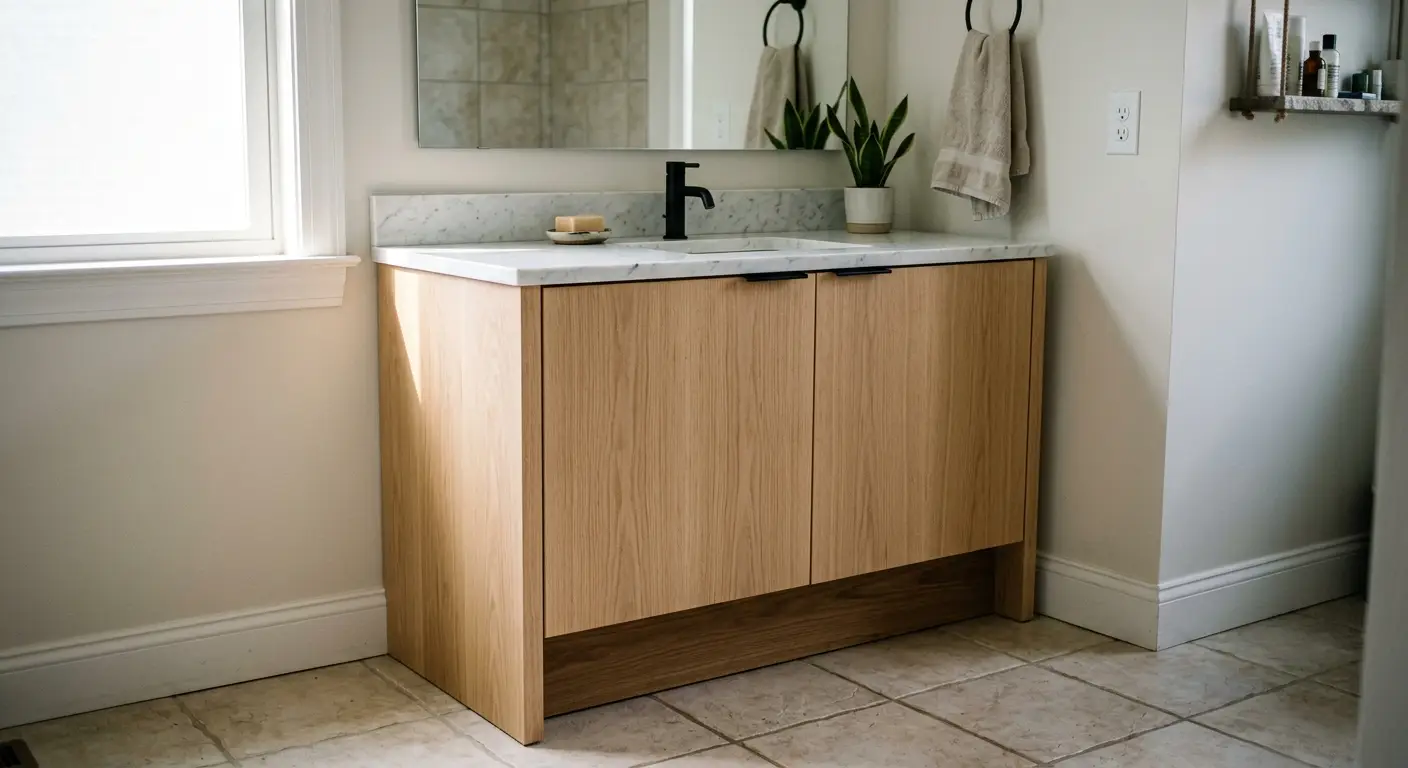
Cathedrals. The wide, nested arches running up the board — so called because they look like a pointed window — are the signature of plain sawn, and they are what most people mean when they picture oak.
The figure is dramatic and it is variable. Every board is different, the arches wander, and across a vanity front or a run of doors you get real movement and character. If you want the wood to be visibly wood, this is the cut that does it.
The flip side is the same sentence read differently: on a large flat surface, strong cathedral figure is busy, and matching boards next to each other so the arches relate rather than argue takes real care in the shop.
What rift sawn looks like
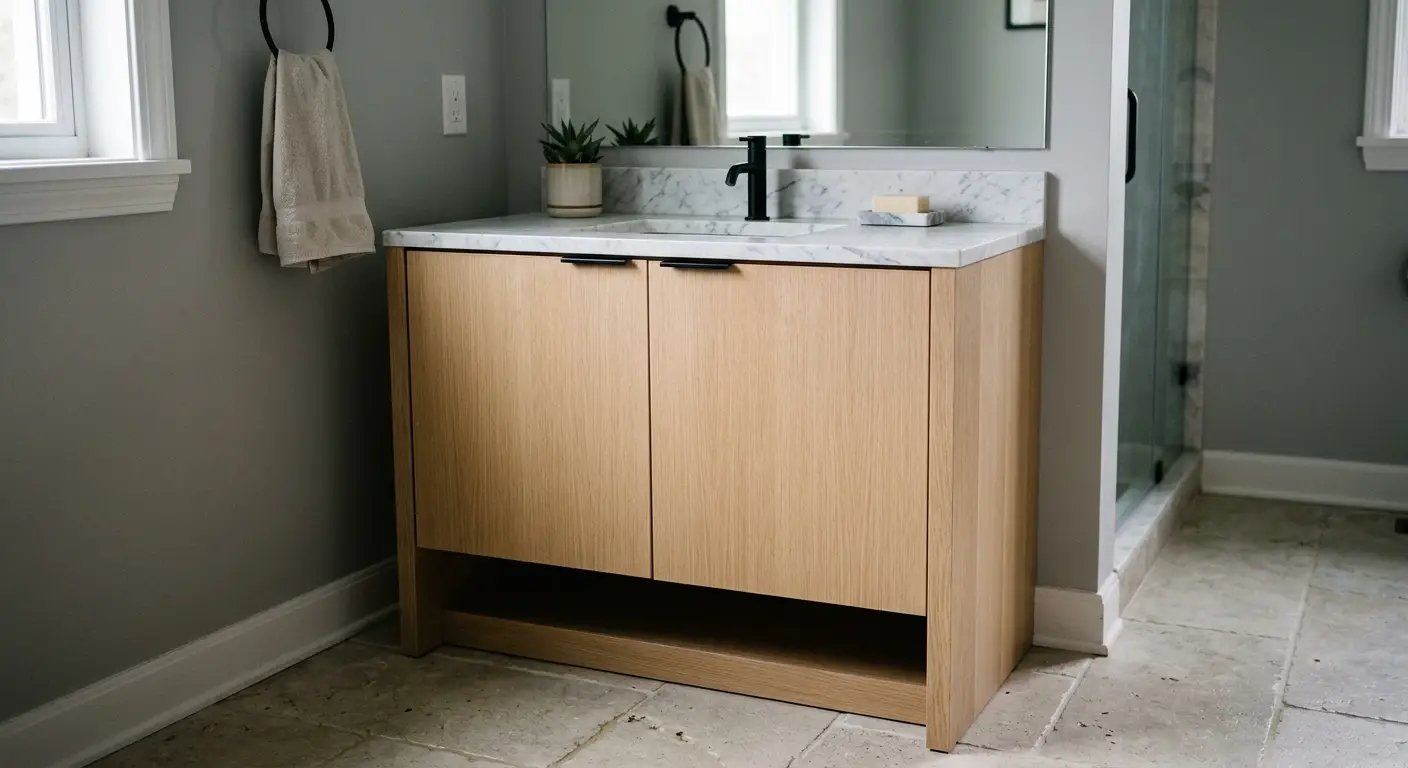
Straight lines, close together, no arches. Rift sawn white oak reads as a fine vertical stripe, sometimes described as ribbon or pencil grain. The grain is still clearly there — white oak has too much texture to look like a painted panel — but it behaves as texture rather than as pattern.
That is why it has become the default in contemporary cabinetry and the thing designers ask for by name. On a wide slab drawer front or a tall door, straight grain stays calm across the whole face and the eye reads the form of the piece rather than the figure on it. Boards also match each other far more easily, because there is no arch to line up.
If you want the quieter, more architectural version of oak, this is it. If you want oak to look like oak in the traditional sense, it is not.
Movement, which is the part that matters in ten years
Wood changes dimension with humidity, and it does so unevenly: it moves roughly twice as much around the rings as it does along them. Which direction ends up across the width of your board is therefore not a detail.
- Rift sawn is the most dimensionally stable cut. The rings run roughly through the thickness, so seasonal change is taken up in the thickness, where nobody can see it. The width stays close to constant and the board stays flat.
- Plain sawn moves most across its width. The rings run roughly across the face, so the seasonal change happens in the width, and the board also has a mild tendency to cup away from the heart over time.
In a house with ordinary year-round humidity, both are perfectly stable in a well-built cabinet — this is what frame-and-panel construction has existed for centuries to handle, and it is why a five-piece door has a floating panel rather than a glued one.
Where it starts to matter is at the extremes: a wide flat slab, a bathroom that swings from steam to dry heat, a house with aggressive winter heating and no humidification, or underfloor heating. In those, rift sawn is not a style preference, it is the engineering answer.
Finish behaves differently too
Worth knowing before you choose a stain, because it surprises people.
Plain sawn oak takes stain unevenly on purpose — the open pores of the cathedral figure drink more pigment than the flat areas, so a stain exaggerates the arches. That can be exactly what you want, and it can also turn a mid brown into something far more striped than the sample suggested.
Rift sawn takes colour more evenly, so a stain reads closer to a solid tone with the grain as texture underneath. If you are after a particular colour rather than a particular pattern, rift gives you more control.
Both are white oak, so both respond the same way to the one real hazard: white oak is high in tannin and will react with iron and with some alkaline cleaners, which is how an oak surface acquires a grey-black stain. Worth knowing in a bathroom.
So which one
Choose rift sawn if the piece has wide flat faces, if the room is contemporary, if you are matching several pieces to each other, if you want the grain quiet, or if the environment is a hard one — a bathroom, a dry-heated house, over a radiant floor.
Choose plain sawn if you want the figure to be the point, if the style is traditional or transitional, or if the piece is made of narrower parts — a five-piece door shows cathedral figure beautifully on the panel and keeps it stable by design.
We build in both on every vanity, along with walnut and knotty alder, so this is a real decision rather than a lecture. The one thing we would say plainly: do not decide from a screen. Oak’s figure and colour are both light-dependent and a photograph flattens both.
Have a look at The Christie and The Caiden in both cuts, see the whole vanity range, or ask us which cut we would use for your room. Everything is built to order in our own shop, fully assembled, with a limited lifetime warranty on materials and workmanship.