Summer 25% discount on all last year's products home decor


How long does it take to get custom cabinet doors?

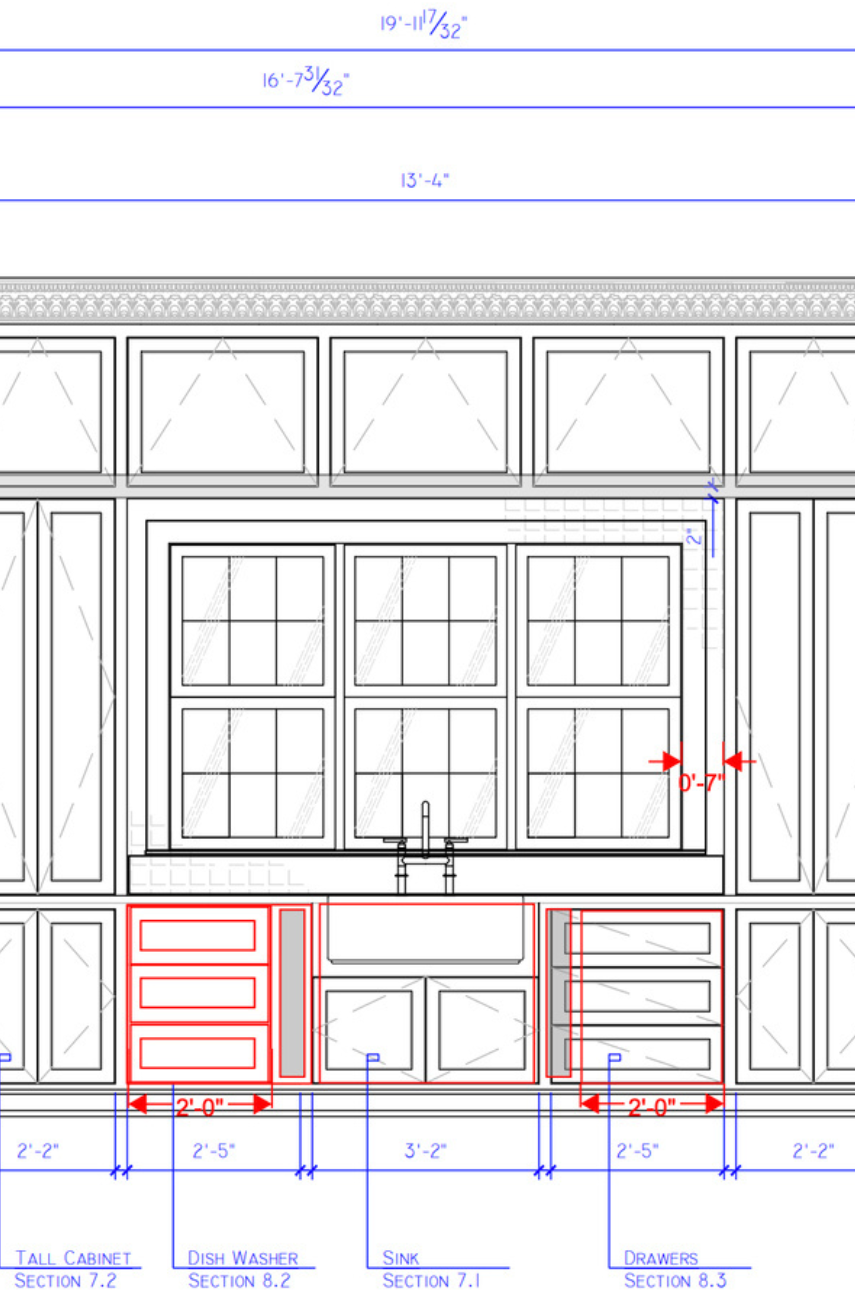
Two weeks from order to shipped, for doors cut to your exact sizes. That covers cutting, assembly, finishing and boring. What adds time is almost never the shop — it is an order that arrived with a missing measurement, which stops the job until somebody answers a question.
| Stage | What happens | Needs from you |
|---|---|---|
| Order placed | Sizes, species, style, finish and boring are locked in | Every measurement, entered in the ordering system |
| Cutting | Each door cut to your dimensions, in sixteenths | Nothing, if the order was complete |
| Assembly | Rails, stiles and panel brought together | Nothing |
| Finishing | Colour or clear finish applied and cured | Nothing, once a sample has settled the colour |
| Boring and packing | Cups and dowel holes cut, doors wrapped | Your boring pattern, given on the order |
How long does it take to get custom cabinet doors?
Two weeks from order to shipped.
That is the number, and it is worth saying plainly because most of this industry will not. The usual answer to this question is a range wide enough to be useless — four to eight weeks, six to ten, “depends on the season” — and the reason is that most suppliers are quoting a queue rather than a process.
Two weeks covers cutting, assembly, finishing, boring and packing, on doors made to your sizes rather than pulled off a shelf.
Why do other suppliers quote four to six weeks?
Three reasons, and only one of them is about the actual making.
- They are quoting a backlog, not a build. A door takes days to make and weeks to reach the front of the queue.
- The order is passed along. A dealer sells, a factory builds, a finisher finishes. Each handoff adds days that nobody is working during.
- The order was incomplete. This is the big one, and it is covered below, because it is the part you can control.
None of that is dishonest. It just means the number you are quoted is mostly waiting rather than working, which is why it varies so much.
What makes an order take longer than two weeks?
Almost always the same thing: something on the order was missing or ambiguous, so the job stopped and a question went out.
An order that sits for three days waiting on an answer about hinge boring is a three-day delay that had nothing to do with the shop’s capacity. This is the single most useful thing to understand about lead times anywhere, not just here.
The things that most often stop a job:
- A door size given without saying whether it is the door or the opening
- Boring requested without saying press-in or screw-in
- A finish chosen from a screen rather than from a sample, then changed after the order
- Drawer fronts left off an order and added later, which splits one batch into two
How do I make sure my order does not stall?
Have everything decided before you sit down to it. Orders go through the ordering system rather than by email, so every number has to be entered — which is an advantage, because the form will not let you leave a field blank and hope.
Before you start, know:
- The width and height of every door and drawer front, measured individually
- Whether those are door sizes or opening sizes, and if openings, what overlay you want
- Your boring: press-in with two 8mm dowel holes, screw-in with the cup alone, or blank
- If you are reusing hinges: cup diameter, cup depth, distance from the door edge to the cup, and the distance from each end to the cup centre
- Species, style and finish, with a sample already seen in your own light
An hour spent with a tape and a notepad is what turns a two-week lead time into an actual two weeks.
Does the size of the order change the lead time?
Not in the way people expect. One door and a kitchen’s worth are both made to order, and the making is not the slow part of anyone’s process.
What a very large order changes is the cost of an error. Twelve doors cut to a wrong overlay is an expensive afternoon; one door is not. That is an argument for checking the measurements on a big order, not for expecting it to take longer.
What is actually happening during those two weeks?
Not queuing, which is the difference.
The doors are cut to your dimensions first — every one individually, because in a made-to-size shop no two orders share a cut list. Then the parts are brought together, and then the whole batch is finished as one, which is the stage that governs the calendar. Finish needs time to cure properly and there is no way to hurry that without paying for it later in a door that marks.
Boring and packing come last, which is deliberate: a door is bored after it is finished so the cup is clean rather than full of colour, and it is wrapped immediately afterwards so the finish is not handled again before it ships.
Should I order samples first, and does that add time?
Order samples first, and treat that as a separate step ahead of the lead time rather than part of it. They are mailed out the same day you order, so it costs you the post and nothing else.
Finish is the decision most likely to be regretted and the one hardest to judge on a screen. A sample in your own kitchen, looked at in morning light and again under the lights in the evening, settles it. A finish changed after the order is placed is the one delay that is genuinely avoidable and genuinely common.
What about trade orders?
Same two weeks. A cabinet shop or contractor ordering doors is on the same process as a homeowner ordering one, which is the point — a shop planning a job around a supplier’s schedule can plan around a fortnight instead of a season.
For a shop, that is the number that matters more than any discount. Two weeks rather than six means a job turned in a third of the time, and a second job started while a competitor is still waiting on doors.
Doors are made from 5 inches by 8 inches up to 49 inches by 96 inches, in sixteenth-of-an-inch increments, bored to your pattern or shipped blank.
Frequently asked questions
Is two weeks the build time or the delivery time?
It is order to shipped. Transit time on top depends on where the doors are going, and it is not included in the two weeks.
Do lead times get longer at certain times of year?
The build does not change. What changes in a busy season anywhere is how long an incomplete order waits for an answer, which is another reason to send a complete one.
Can I get doors faster than two weeks?
Ask. Two weeks is the standard process rather than a queue, so an urgent job is a conversation rather than a flat no.
How long do samples take?
They are mailed out the same day you order, separately from and ahead of any door order. So there is no reason to wait until you are ready to buy — request them as soon as you are thinking about a finish.
What if a door arrives wrong?
Tell us. It is rare — in five years we have got a size wrong twice — but when it happens it gets remade. What takes longer to resolve is a door built correctly to a measurement that was taken wrongly, which is why the measuring guidance is worth the twenty minutes.
One thought on “How long does it take to get custom cabinet doors?”